Prior to the consecration of Christ Church in 1820, Burntwood burials took place at St Michael’s Lichfield. It’s a long way to carry a coffin and we know at some point a parish hearse was provided to help lighten the load. Records from 1769 reveal that Mrs Elizabeth Ball left money to help with its repairs and for the upkeep of the hearse house, where it would have been kept in-between burials. In the 1880s, the Reverend Weston asked what had happened to both the house and the money, as no trace could be found of either.
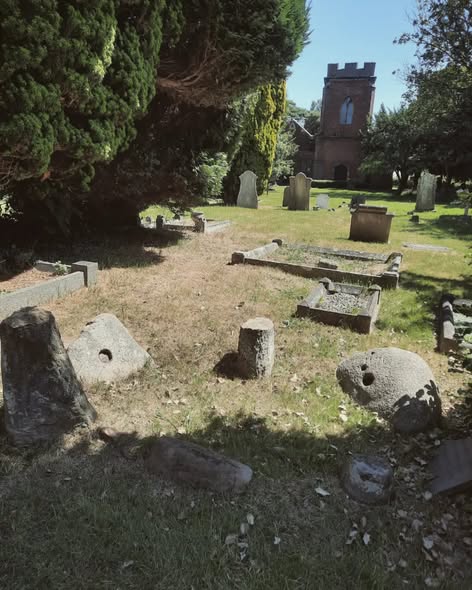
One intriguing feature I’d like to investigate further is an inscription scratched into one of the panes, which apparently reads, ‘John Clark made these windows 16th December in the yere of our Lord, 1819, Litchfield’. There are also rumours that some of the other glass in the old windows dated back to the 14th century and may have originally been from Lichfield Cathedral. Out in the church yard are several nailers’ stones, survivors from a time when nail making was a hugely important cottage industry which supplemented the income of many Burntwood agricultural labourers.
The Christ Church vicarage was a former farmhouse donated by Sir Robert Peel. When it was being redecorated in 1923, a painting of a bearded cherub alongside the inscription ‘Charles Wade, John Wade. February 22nd, 1759.’, was uncovered and, again, I have several questions… A tragedy took place there in May 1852 when the Reverend Errington climbed a ladder to destroy the nests of some sparrows in a pear tree. As he stepped from the ladder onto a branch, it gave way and the vicar fell 20 foot, breaking his neck.
The first baptism here was that of Elias Ashmole on July 16th 1820 and the first burial was Ann Craddock on July 25th 1820. Not all of those who followed her into the churchyard went gently into that good night. John Westwood died in November 1843 and his wife Sarah was convicted of killing him with arsenic. She was executed and interred at Stafford Gaol on 13th January 1844, the last woman to be hanged in Staffordshire. Sarah swore she was innocent until the very end. Her final words were, ‘It is hard to die for a thing one is innocent of’.
There was talk of another possible poisoning in April 1856 when someone suggested that the death of a local woman, Catherine Ashmall of Edial in 1855, may not have been from natural causes.
Permission was granted from the Home Office to exhume her corpse from the churchyard and it was carried for a quarter of a mile by local police officers to a barn at the family farm. A jury assembled at The Star Inn for the inquest, part of which included the grim task of viewing the body. It was adjourned to allow a full post mortem to take place and reconvened later that month to hear the coroner’s report.
It concluded that Mrs Ashmall had not been murdered. Indeed, the only poison to be found here was the toxic talk of the vicious rumour monger. It’s said he was present in the pub on the day that the verdict was announced and was hissed and hooted at as he left, only narrowly avoiding a ducking in the horse trough from some of the villagers thanks to the intervention of the landlady.
Christ Church is not the only graveyard in this part of Burntwood which has tales to tell however…
 Lichfield Discovered
Leave a comment